
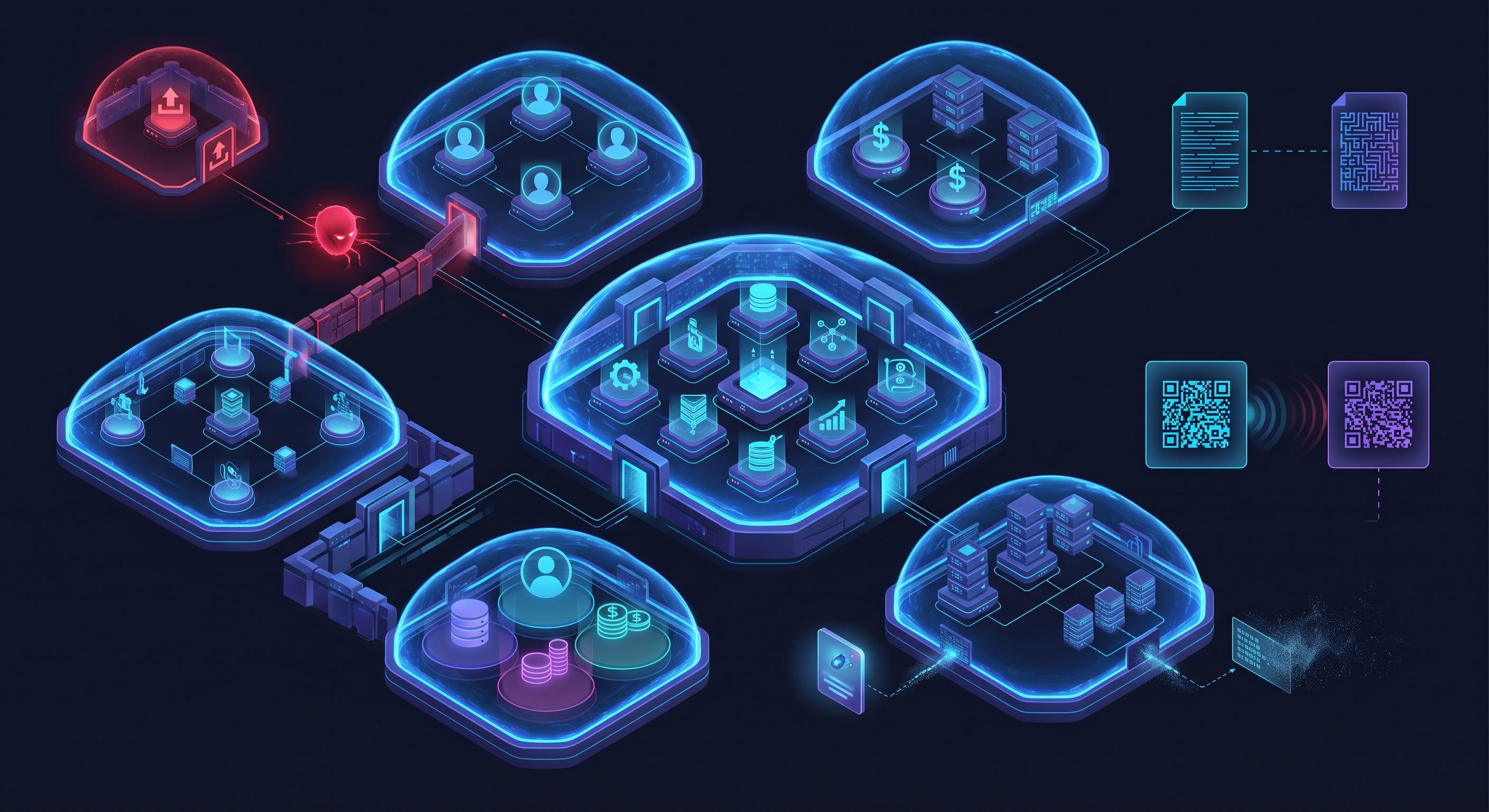
The Hugging Face compromise that came out a couple of weeks ago got me thinking about security first principles. It looks like the Hugging Face attack happened because OpenAI AI agents found a link between the dataset upload capability and the production infrastructure. To me, that seems more like a fundamental issue than what actually caused the compromise. The core issue is that there was a way to get from the upload space into the production space.
I think it’s pretty clear now, especially with the extensive use of AI for both white-hat and black-hat hackers to evaluate systems, that if a system can be compromised, it will, and all systems can be compromised. That doesn’t mean we should give up on security entirely. We still need to follow best practices and secure systems as much as possible. I think AI can help with that, but we must always assume the system will be compromised at some point, and we need to plan for it.
For application and network design, we should always assume something will be compromised. The first question we should be asking is, “When this component is compromised, what is the fallout of that? What’s the end result? What do we lose?” Compartmentalize components so a breach in one system doesn't immediately compromise all other systems. No components should connect unless they absolutely need to.
A Different Perspective
Another way to look at this is not from the application and network point of view, but from the information point of view. Are you working with different types of data? Do applications need to have access to more than one type of data? What credentials should allow access to which set of data? Look at subsets of data, then look at each subset and identify the risk: what happens if and when it's compromised. If the data does not need to be shared, make it architecturally impossible for them to access each other.
If they do need to be shared, remove shared namespace identifiers between datasets. If you separate, for example, user data from financial data, use a random UUID in one domain that has no meaning in the other domain. If the data is compromised, this prevents anyone who compromises two datasets from correlating them.
Another issue that came out of the Hugging Face compromise is credential validity. Long-lived credentials give attackers more time to operate. Credentials should be short-lived and scoped to the data and its intended use. If a transaction should take no longer than 5 minutes, a credential valid for 24 hours leaves the door open.
In the Hugging Face incident, the agent could read environment variables for the processing pod. It doesn’t look like these variables need to exist at all in the upload functionality. They should have been generated only for the job and disposed of immediately afterward.
Map your system not as components but as information domains. What information naturally clusters? User secrets shouldn’t be in the same namespace as infrastructure topology. Financial data can be separated from user information. Build trust boundaries around information, not services. Then ask: what’s the minimum audience for each domain? Design access so learning information in one domain doesn’t grant visibility into another.